
The exhibition “For Ukraine, for its will” chronologically covers a small period (2013-2024) filled with tragic events in the history of Ukraine. It begins with the events of Euromaidan and the Revolution of Dignity, which became a prerequisite for the Russian-Ukrainian war. The following sections are devoted to the events of the ATO/JOU, the full-scale invasion and the participation of Transcarpathians in them. The exhibition is designed to honor the soldiers who defend the independence and sovereignty of Ukraine and to remember all the heroes who gave their lives for Ukraine and for our freedom.
On November 21, 2013, many people rallied on social networks and took to the square in Kyiv to protest against the refusal of pro-Russian President Viktor Yanukovych to sign the Association Agreement between Ukraine and the European Union. In various cities of Ukraine, daily actions in support of European integration began to be organized. On the night of November 29-30, armed Berkut soldiers forcibly removed people from the square, using explosive packages. They beat people with batons and trampled them with their feet.
Due to the brutal dispersal of the protesters, hundreds of thousands of people gathered in the center of Kyiv on December 1. The actions of the authorities raised citizens outraged by corruption, usurpation of power, violation of human rights, and the policy of rapprochement with Russia. Because of the European integration slogans, the protests were called Euromaidan. Later, it was called the Revolution of Dignity.
The impetus for further escalation of the confrontation was the adoption of “dictatorial laws” by the Verkhovna Rada of Ukraine on January 16, 2014. They restricted the rights of citizens and expanded the powers of special forces to punish participants in the protests. On January 19, the Euromaidan activists began a march to prepare for an indefinite picket of the Verkhovna Rada of Ukraine. The march met with units of internal troops and special forces of the Berkut on Hrushevskoho Street – clashes began that lasted all night. On January 22, for the first time during the Revolution of Dignity, two activists died. Hundreds of protesters were injured.
At the end of January, mass demonstrations also spread to other regions of Ukraine. Protesters occupied administrative buildings and removed pro-Russian heads of state administrations from their posts. These protests were a reaction of the people to the intensification of the Euromaidan confrontation after the adoption of “dictatorial laws”.
Transcarpathians supported Euromaidan from the first days and took to a mass rally in Uzhhorod on Teatralna Square and other cities. The most active were students, participants of patriotic Ukrainian youth organizations, members of the All-Ukrainian Union “Svoboda” and others. Hundreds of our compatriots joined the Euromaidan activists in Kyiv, understanding that everything would be decided in the capital. Humanitarian aid was regularly sent from Transcarpathia for the needs of the Kyiv Euromaidan. At the end of January 2014, the blockade of the Transcarpathian Regional State Administration building began in Uzhgorod. A tent camp was set up on Narodnaya Square and barricades were erected. Active citizens from different regions of the region came here by bus. All these events can be seen in the photo illustrations placed in this section of the exhibition. Among the original exhibits, special attention should be paid to the flags of Euromaidan activists from Uzhgorod and Tyachev, protective equipment and belongings of the participants of those events O. Volosyansky and I. Richter and other activists, a fragment from the Lenin monument in Kyiv. This section also created the installation “Transcarpathians on the Square”. It is filled with original objects from the Uzhgorod and Kyiv Euromaidans.
The events of February 20 on Instytutska Street in Kyiv entered the modern history of Ukraine as “Bloody Thursday”. On that day, snipers killed 48 Euromaidan activists. On the night of February 21-22, Viktor Yanukovych and his inner circle fled to Russia. On the same day, Russia began its occupation of Crimea.
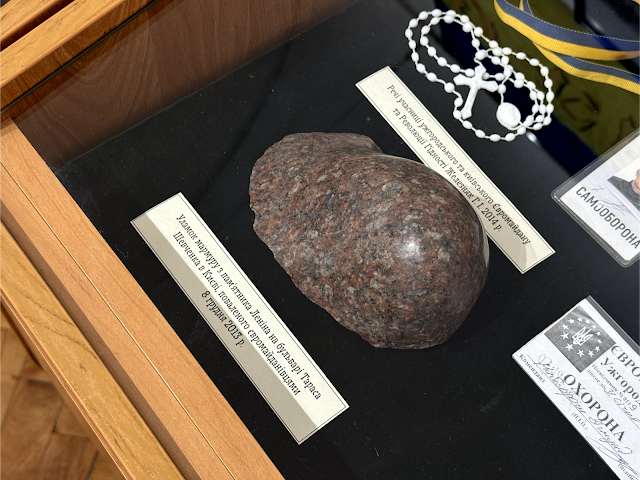
“A fragment from the Lenin monument, toppled by Euromaidan protesters”
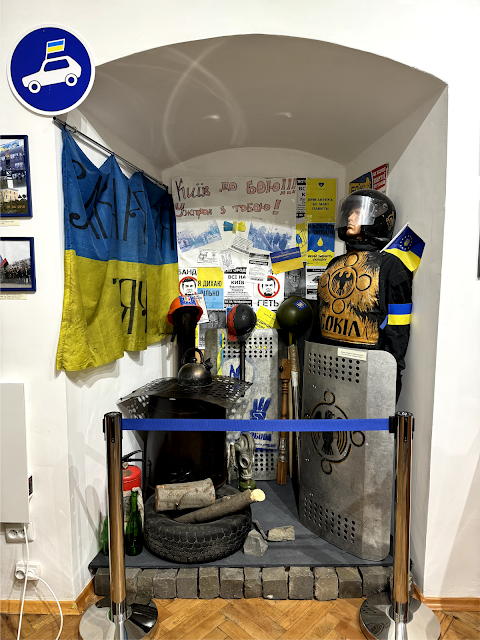
“Installations “Transcarpathians on the Maidan”
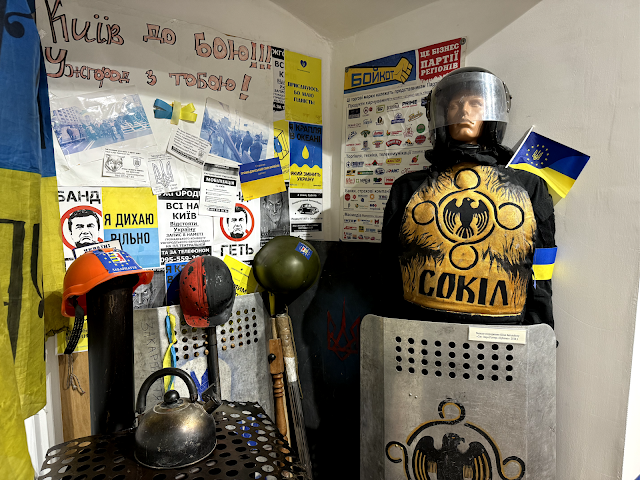
“Protective equipment for Euromaidan participants”
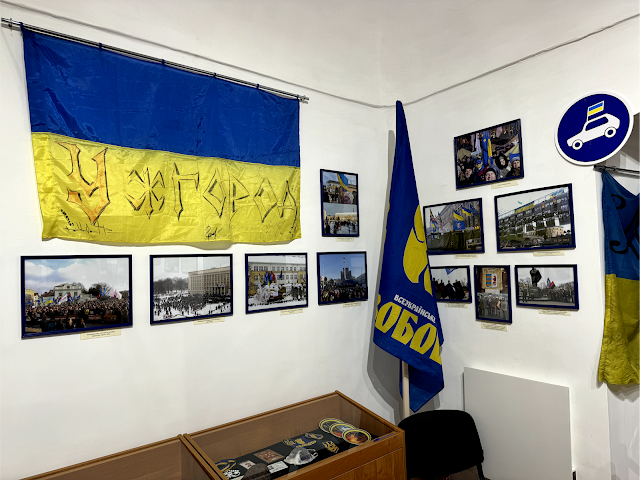
“Flag of Euromaidanists from Uzhhorod”
On April 14, 2014, the acting president of Ukraine Oleksandr Turchynov announced the start of an anti-terrorist operation involving the Armed Forces of Ukraine (ATO). This decision was made after the separatists led by officers of the Russian special services seized the Ukrainian cities of Sloviansk, Kramatorsk, Druzhkivka, etc. On April 7, the so-called Donetsk People’s Republic (DPR) was proclaimed in Donetsk and the Russian president was asked to send troops to Donbas. Later, the situation repeated itself in Luhansk – on April 28, the LPR was “created”. The state administration in Kharkiv was seized.
The first serious combat clash between the Ukrainian military and illegal armed formations took place on May 2, when an ATO helicopter was shot down in the sky over Sloviansk with the help of MANPADS, which confirmed the involvement of qualified Russian military personnel. On May 26, the first large-scale operation of the Ukrainian military was carried out: with the participation of aviation and landing, the battle for Donetsk airport took place. On June 4, Lyman was liberated, and on the 13th, Mariupol.
In early July, the ATO forces launched a rapid offensive. On July 5, they liberated Sloviansk and Kramatorsk, the next day – Bakhmut, on July 21 – Toretsk, on July 30 – Avdiivka, on August 1 – Krasnohorivka, on August 5 – Maryinka, and the fighting moved to the south of Donbas.
In August 2014, the Ukrainian military fought for the city of Ilovaisk. The ATO forces almost managed to capture the city, but after the direct intervention of Russian regular troops at the end of August, the Ilovaisk group found itself surrounded. This led to the loss of control over certain areas of Donetsk and Luhansk regions and the signing of the Minsk agreements in September 2014.
Another escalation on the front occurred in January-February 2015. The most difficult situation was in the area of Donetsk airport and Debaltseve. The militants, with the support of units of the Russian armed forces, tried at all costs to eliminate the Debaltseve salient and capture Donetsk airport, thereby forcing Ukraine to make political concessions. On February 12, agreements were reached in Minsk on a new ceasefire, which were enshrined in the “Complex of measures for the implementation of the Minsk agreements”. These agreements ended the active phase of the ATO. Instead of the anti-terrorist operation, which officially ended on April 30, 2018, the start of a joint forces operation (JFO) was announced.
Transcarpathian military units took an active part in the ATO from the first days. Servicemen of the 128th OGShBr held positions in the Luhansk region near Lysychansk, Severodonetsk and Rubizhne, participated in the battles near Debaltseve near the city of Artemivsk (Bakhmut). Border guards of the Chop and Mukachevo border detachments, employees of the special forces of the Ministry of Internal Affairs from Transcarpathia took part in the ATO. Many Transcarpathians joined the ranks of voluntary military formations. This section presents military equipment and personal belongings of servicemen who participated in those events (servicemen Vasyl Nalyvayk, Yuriy Vatsyk and Yuriy Kramarenko). The flag of the 128th OGShBr burned in the battles and the road sign “Sands” are very valuable and original. A separate display case displays exhibits donated by the humanitarian mission to search for the fallen to the NGO “Union “Narodna Pam’yat”, which were found in the area of the battles for Ilovaisk. This section is supplemented by scientific and illustrative material.
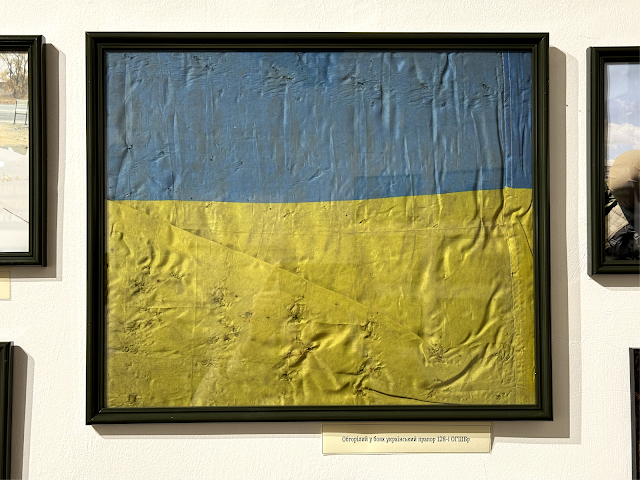
“The Ukrainian flag of the 128th OGShBr burned in battle”
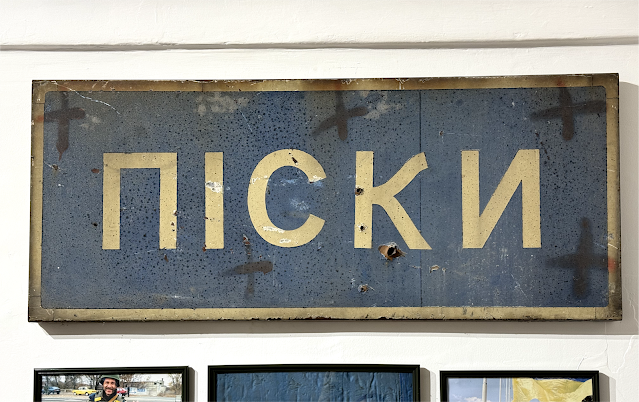
“Road sign “Pisky“
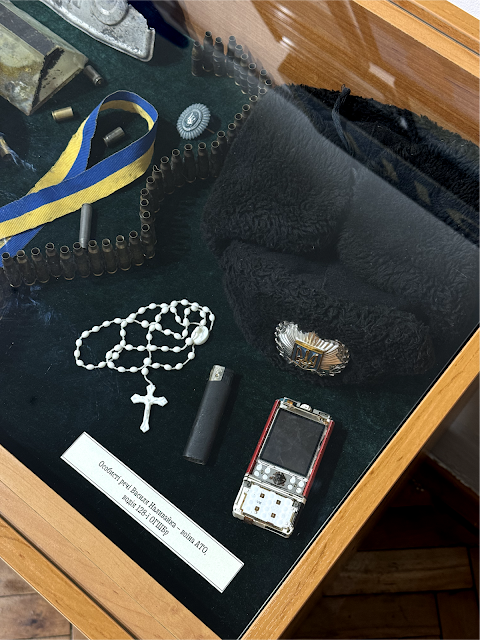
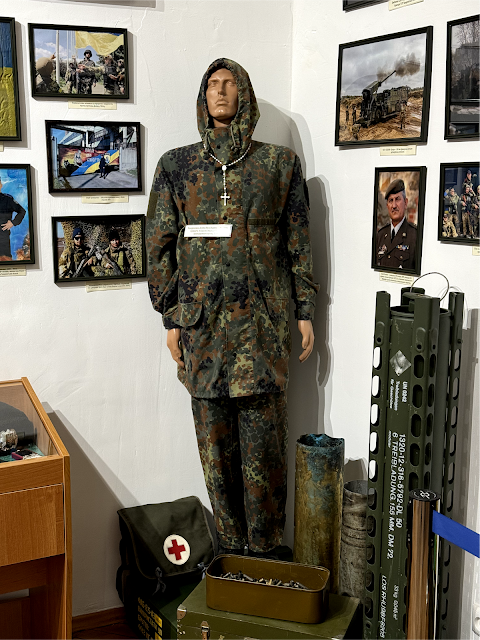
“Personal belongings of military personnel”
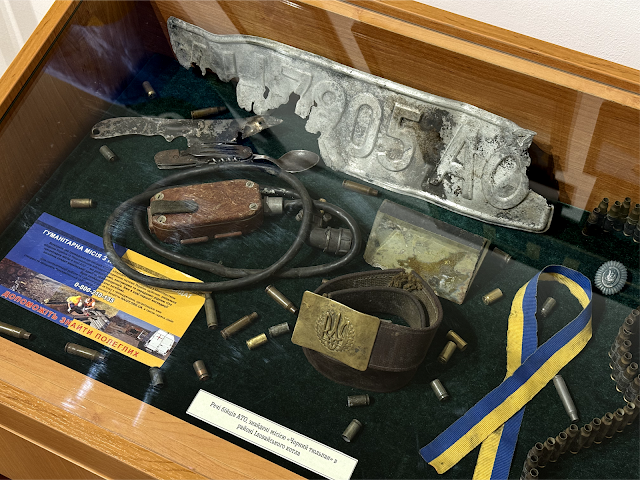
“Things of ATO fighters found in the Ilovaisk boiler area”
On the morning of February 24, 2022, Russian President Putin announced the start of a “special military operation.” He called its goal “demilitarization and denazification of Ukraine.” Within minutes, Russian missiles attacked Ukrainian airfields and military facilities throughout Ukraine, and an open armed invasion of Russians from the territory of Belarus and temporarily occupied Crimea began.
Under the far-fetched pretext of protecting the Russian-speaking population in our country, the Kremlin set itself the goal of militarily destroying the Ukrainian state and its identity. Putin planned a blitzkrieg: to land troops at the Gostomel airfield and capture Kyiv. At the same time, a strike was launched from the north on Chernihiv, Sumy, and Kharkiv, and from the south on Odessa, Mykolaiv, Kherson, and Mariupol.
The main episodes of the full-scale war include the battle for Kyiv, which lasted from February 24 to April 1, 2022. The stubborn resistance of the Armed Forces of Ukraine thwarted the Russian plans. Due to the futility of attempts to break through to Kyiv, at the end of March the Russian command decided to withdraw troops from the Kyiv region. The key episodes of the battle for Kyiv were the battles for Irpin, Vorzel, Bucha, and Gostomel. On March 19, units of the Defense Forces of Ukraine launched a counteroffensive. The enemy began to retreat. The battles for Mariupol became significant in 2022. The Defense Forces of Ukraine were forced to retreat to the city and conduct a circular defense against the superior enemy forces. Since April 21, the only stronghold of the defenders in Mariupol has been the Azovstal steelworks.
After the failure of the initial plan to quickly seize Ukraine, the enemy regrouped its troops and continued its creeping offensive in several directions.
In early autumn 2022, the enemy lost the initiative and was forced to take measures to maintain its position in the occupied territories. The Ukrainian Defense Forces conducted a number of offensive operations at this time. The first of these was the Kharkiv offensive operation, launched on September 5. Taken by surprise, enemy units in the Kharkiv region began to retreat. The Armed Forces of Ukraine liberated up to 500 settlements, including the cities of Izyum, Balakliya, and Kupyansk. The Kherson offensive operation was also successfully carried out in the fall of 2022, during which Kherson and more than 200 settlements were liberated from the invader.
From the very beginning of the war, the victims of Russian air strikes were primarily peaceful Ukrainian cities and villages, infrastructure, and energy. The geography of the strikes covered all regions of Ukraine. Russian troops are destroying not only airfields, military units, oil depots, but also residential buildings, maternity hospitals, hospitals, kindergartens, schools, etc.
Over the more than two years of the great war since the beginning of the full-scale invasion, the Ukrainian Defense Forces have thwarted all the plans of the Russian aggressors, forcing them to abandon the capture of Kyiv, the landing of the Marines in the Odessa region, and the exit to Transnistria. Now the Russians are focused on capturing the Donetsk and Luhansk regions and holding the temporarily occupied parts of the Kherson and Zaporizhia regions. The undisputed success of Ukraine in 2023 was the elimination of the dominance of the Russian fleet in the Black Sea.
Today, Ukraine is deterring Russian armed aggression thanks to efforts on the military, diplomatic, and information fronts, as well as powerful international assistance.
The central place in the exposition is occupied by a museum installation, which symbolizes Russian aggression against Ukraine. Here are exhibited fragments of deadly weapons, with which Ukrainian fighters have been shelling positions for more than two years, destroying cities, infrastructure and civilians. This section exhibits samples of captured weapons and ammunition, captured by Ukrainian soldiers in battles and later transferred to our museum. Also presented are weapons used by the Armed Forces of Ukraine and, in particular, those transferred by Ukraine’s allies. In the photographs, you can see the symbols and emblems of military units from Transcarpathia, famous compatriots who take an active part in repelling enemy aggression. A separate section in the exposition is dedicated to honoring the memory of Transcarpathians who gave their lives for the Ukrainian state. Photos of heroes who died are constantly changing on the TV screen and this should be a constant reminder of the high price paid for our freedom.
The museum exhibits presented in this section were collected thanks to the serviceman Oleksandr Volosyansky, war veteran, volunteer Yevhen Joni, serviceman, professor Fedor Shandor, servicemen Oleksandr Miroshnychenko and Oleksandr Alferov, war veteran, volunteer Oleksandr Pantsulych, volunteer Andriy Lyubka, servicemen of the 15th separate mountain assault detachment and many others. They transferred to the museum the items that became the content of this section of the exposition.
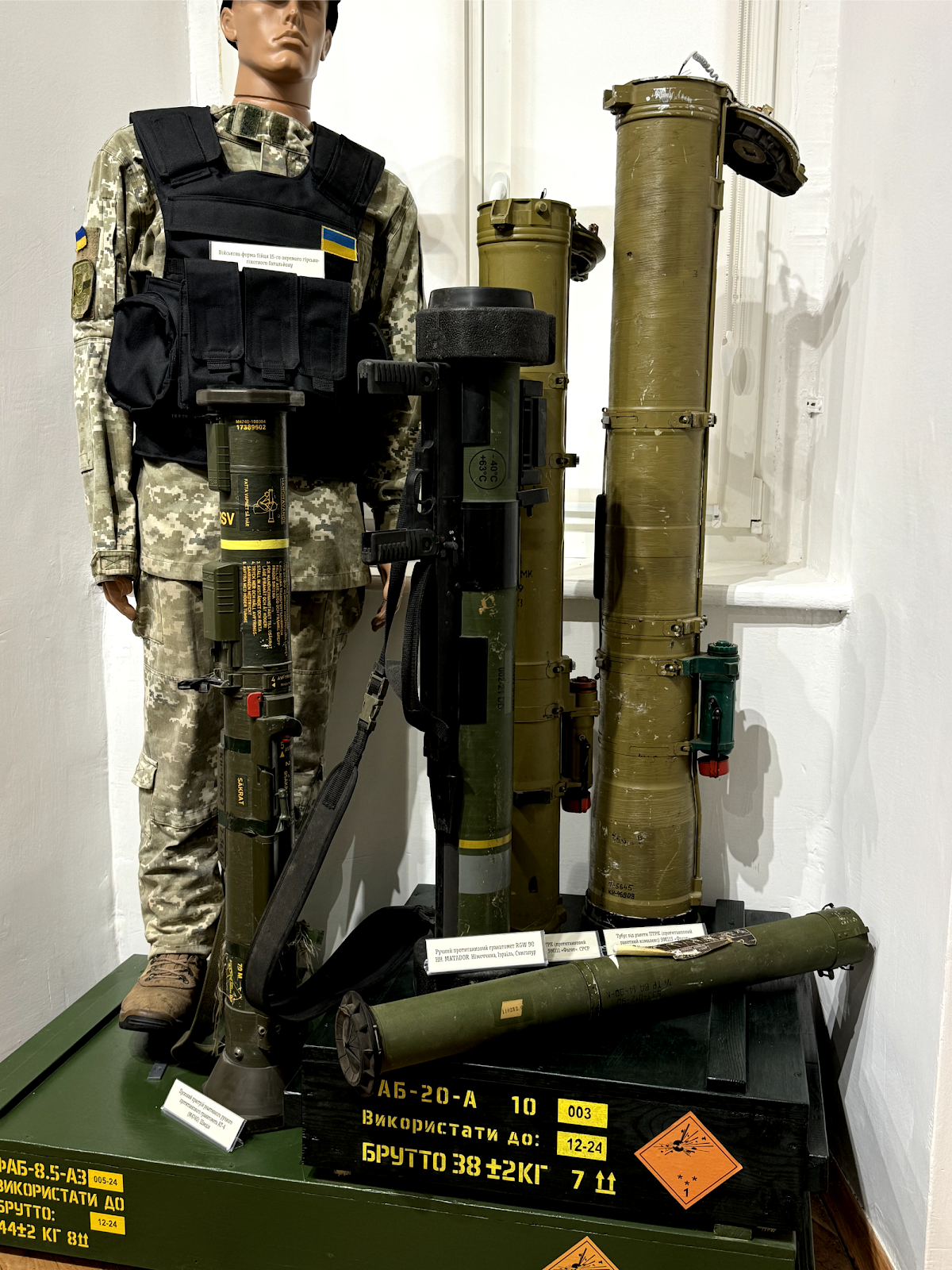
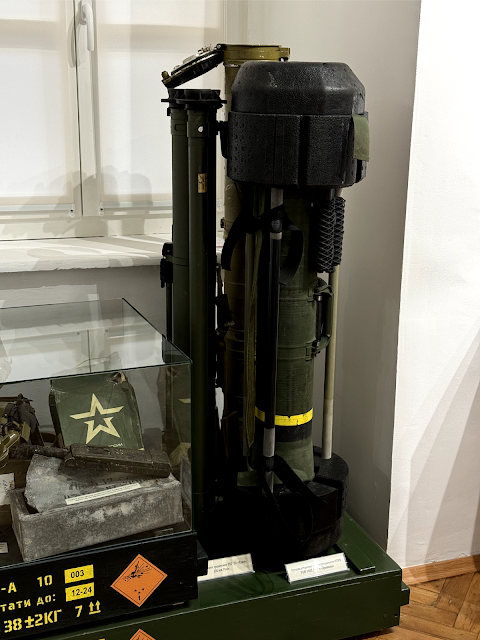
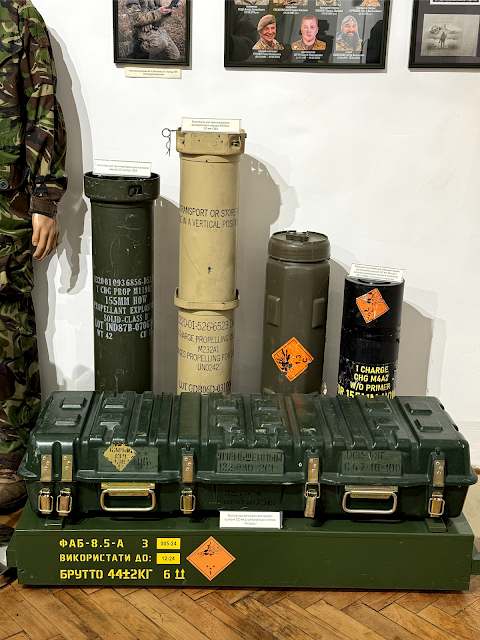
“Weapons transferred by Ukraine’s allies and captured weapons captured by the Armed Forces of Ukraine in battles”
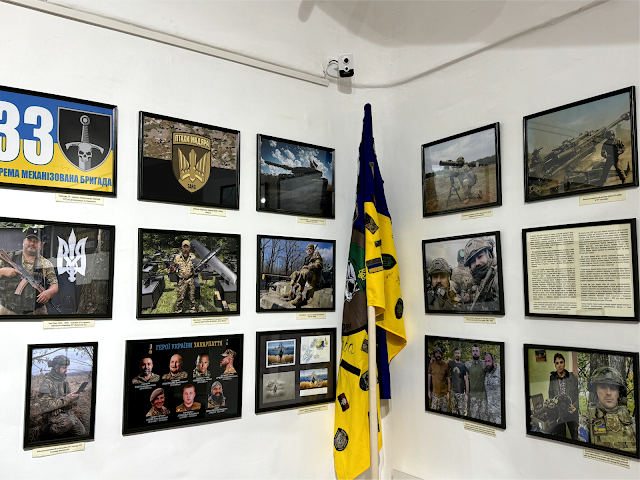
“Symbolism of military units of Transcarpathia”
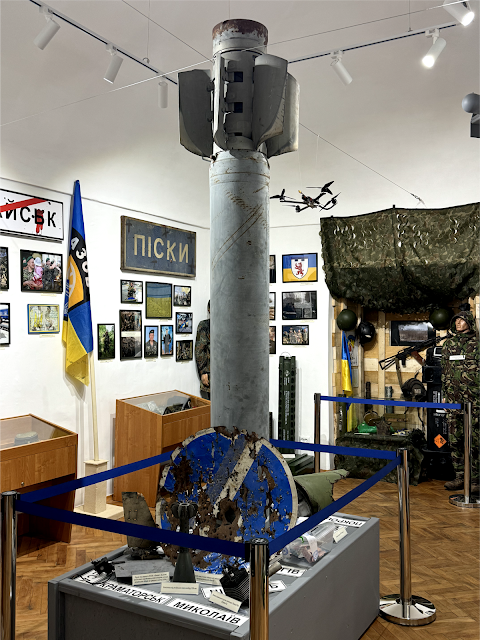
“Metal debris”